ActiveCampaign and Mailchimp are two of the best-known email marketing platforms for US businesses, but they are built for different people. ActiveCampaign is the automation specialist: a visual workflow builder, behavioral triggers and a native AI layer called Active Intelligence sit at the center of the product. Mailchimp is the familiar all-rounder: a permanent free plan, a low entry price and the easiest first experience in the category. This is an independent comparison on real US pricing and capability, so you can see which one fits before you commit.
We may earn a commission when you sign up through some links on this page. This never affects our rankings or the data shown. Read our terms.
Quick verdict
Choose ActiveCampaign if automation is the point: you want lifecycle workflows, behavioral and purchase triggers, strong deliverability and AI that helps build and optimize campaigns, and you are willing to pay from day one for it. You can start an ActiveCampaign trial and test the workflow builder before you pay.
Choose Mailchimp if you want the cheapest, simplest start: a real free plan for a small list, a low entry price and the most beginner-friendly editor in the category, with automation that covers the basics.
In one line: ActiveCampaign is the better automation engine, Mailchimp is the better place to start for free.
Pricing and billing compared
Plans and pricing checked October 2026, and every figure below is read live from our pricing database.
Mailchimp wins on getting started. Its free plan is Yes (250 contacts, 500 sends /mo), and its first paid plan is $13/mo (Essentials). ActiveCampaign's free plan is No (14-day trial), and it bills from $15/mo (Starter). For a brand-new sender that free tier is a genuine advantage, though note the entry prices themselves are only a couple of dollars apart, so the free plan is the real difference at the bottom, not the paid rate.
The gap narrows the moment you need automation. Mailchimp's workflows are Basic (Essentials), Advanced (Standard+), while ActiveCampaign's are Advanced (Plus+); Basic (Starter). Compared at that level the two are much closer on price, and ActiveCampaign includes more at the same tier. Both bill per contact in US dollars, but the billing bases differ in a way that matters: Mailchimp counts All contacts including unsubscribed, so an uncleaned list quietly costs more, against ActiveCampaign's All contacts (active + inactive). The calculator on this page folds your real contact count into a monthly figure for each, which is the honest way to price them.
Automation and AI
This is where ActiveCampaign earns its reputation. Its visual automation builder handles multi-step, conditional workflows triggered by behavior, purchases and engagement, and that depth is the main reason businesses move to it. On top of the builder sits Active Intelligence, ActiveCampaign's native AI layer, alongside AI agents that help generate campaigns, score leads and optimize send timing. ActiveCampaign also ships a native, official MCP integration, so it plugs into modern AI tooling directly rather than through a workaround.
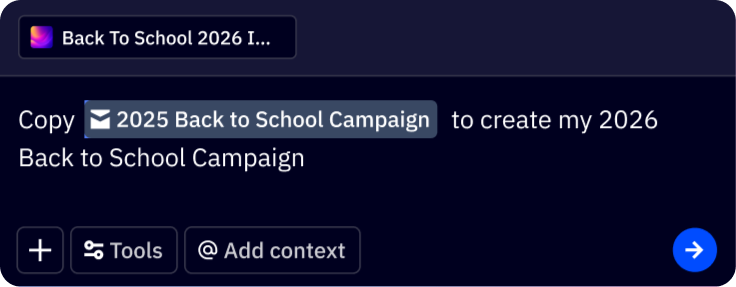
ActiveCampaign's Active Intelligence reusing a past campaign to build a new one. Screenshot: ActiveCampaign.
Mailchimp is not without AI: it has its own Intuit Assist features and a set of generative tools, and for newsletters and simple journeys its automation is perfectly capable. But its advanced automation lives on the Standard plan, it is more general-purpose than ActiveCampaign's, and its AI-agent and MCP support currently runs through third-party tools like Zapier rather than natively. If you are switching specifically to do more with automation and AI, ActiveCampaign is the stronger platform; if you mainly send broadcasts, the difference will matter less.
Deliverability
Getting into the inbox is the whole job, and here ActiveCampaign has the better independent record: Very high (94% in independent tests) against Mailchimp's High (89% in independent tests). Both are reputable senders and your own list quality and sending habits matter more than the logo on the dashboard, but if a few points of inbox placement turn into real revenue at your volume, that gap is worth weighing. These scores come from independent third-party testing, not our own lab.
Integrations, templates and ratings
ActiveCampaign connects to more of the rest of your stack, listing 900+ integrations against Mailchimp's 300+, and it ships 250+ email templates against Mailchimp's 100+, with deeper conditional content. Segmentation follows the same pattern: ActiveCampaign's is Advanced (behavioral, purchase, engagement), Mailchimp's is Moderate (tags, predicted demographics).
Mailchimp counters with ubiquity: it is the platform most people have already used, and that familiarity shows in its review base. ActiveCampaign rates 4.6 from 2,561 reviews, against Mailchimp's 4.5 from 17,624 reviews, which is a reminder of how widely it is deployed rather than a quality gap.
Where Mailchimp is the better choice
Independence cuts both ways, so this matters: Mailchimp genuinely wins for a real set of users. If you are starting from zero and want to spend nothing, its free plan is the easiest on-ramp in the category. If you value a familiar, beginner-friendly editor and a vast library of guides over automation depth, Mailchimp gets you sending faster. And if your needs are mostly newsletters and light journeys, you may never use the automation that justifies ActiveCampaign's price. Acknowledging that is the point of an independent comparison.
Who each one is for
ActiveCampaign suits businesses that run real lifecycle marketing: behavioral and purchase-triggered automation, segmentation that reacts to engagement, AI assistance through Active Intelligence, and deliverability they can count on. It rewards the time you invest in building workflows, and it expects you to pay from the first month.
Mailchimp suits beginners and small senders who want the cheapest, simplest start, a recognizable tool and a free plan to test the water, and who are happy with automation that covers the basics rather than the edges.
Pros and cons for this matchup
ActiveCampaign wins on automation depth, on behavioral and purchase-based segmentation, on measured deliverability, on a much larger integration library and template set, on A/B testing being available at Yes (all plans) where Mailchimp gates it to Yes (Standard+), on support (24/7 chat against Business hours), and on being the only one of the two with a native AI agent connection rather than a Zapier workaround. It loses on having no free plan at all, on a steeper learning curve, and on a slightly higher entry price.
Mailchimp wins on a permanent free plan a beginner can actually start on, on the friendliest editor in the category, on brand familiarity that makes hiring and handover easier, and on a marginally lower entry price. It loses on automation depth, on segmentation that cannot slice by behavior the way ActiveCampaign can, on gating A/B testing behind a higher tier, on a smaller integration and template library, and on billing you for contacts who have already unsubscribed until you remove them by hand.
The verdict
Decide by what you are actually buying. If you are switching for automation, AI and deliverability, ActiveCampaign is the stronger engine and the one built for that work, and you can try ActiveCampaign before committing. If you want a free, familiar, low-cost place to begin, Mailchimp is the easier and cheaper starting point. Map your own contact count into the calculator above, and the platform that fits your plan and your budget becomes clear.